
- Building Resources
- Construction Loans
- Cost Estimating Explained
- Cost to Build a House
- Cost to Build by State
- Energy Efficient Homes
- Foundation & Basement Information
- Heat Pumps
- Hot Water Recirculation
- House Plans, Reading
- Insulation-Calculator
- Kitchen 1- Design
- Modular vs Stick Built
- Permits, Fees, Surveys
- Radiant Heating
- Remodeling & Additions
- Shell Builders
- Siding-Cement
- Skylights
- Solar Modules
- Stair Building and Design
- Steel Framed Homes
- Subcontractors
- Tankless Water Heaters
- CLICK HERE FOR HUNDREDS OF MORE CATEGORIES
- Build a House
Solar Roof Shingles
Solar Roof Shingles
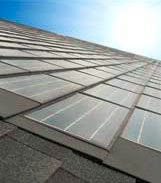
I note there are solar panels that are similar to roof tiles and appear to be part of the roof and not the present unsightly solar panels. Do you have the manufacturer of these solar panels?
Paul
Hi Paul,
I believe you are referring to solar shingles.
A list of manufactures can be found at: EcoBusinessLinks.com
More on Solar Electric Systems:
Solar electric systems, also known as photovoltaic (PV) systems, convert sunlight into electricity.
Solar cells—the basic building blocks of a PV system—consist of semiconductor materials. When sunlight is absorbed by these materials, the solar energy knocks electrons loose from their atoms.
This phenomenon is called the "photoelectric effect." These free electrons then travel into a circuit built into the solar cell to form electrical current.
To see a simulation of the photoelectric effect, you can view this animation. Only sunlight of certain wavelengths will work efficiently to create electricity.
PV systems can still produce electricity on cloudy days, but not as much as on a sunny day.
The basic PV or solar cell typically produces only a small amount of power. To produce more power, solar cells (about 40) can be interconnected to form panels or modules. PV modules range in output from 10 to 300 watts.
If more power is needed, several modules can be installed on a building or at ground-level in a rack to form a PV array. About 10–20 PV arrays can provide enough power for a household.
PV arrays can be mounted at a fixed angle facing south, or they can be mounted on a tracking device that follows the sun, allowing them to capture the most sunlight over the course of a day.
Because of their modularity, PV systems can be designed to meet any electrical requirement, no matter how large or how small. 
Note: In some areas of the country, you can connect solar panels or solar shingles to an electric distribution system (grid-connected) for an energy credit.
You can watch your electric meter run backwards! Yikes! :)
If they stand alone (off-grid), you will probably never recover the additional cost of the solar system.
Local "groups" need to get active and get their local electric utility to "Get Green" and provide for "on-grid" systems.
Don't have a group? Start one!
Since the turn of the century, there have been major advancements in solar power and their efficiency; this includes the 2005 release of solar shingles.
Here’s how they work.
They act as any normal solar energy system would.
They capture sunlight and transform it into energy. Most Solar Shingles are 12 inches wide (when stacked have 5inches of exposed area) by 86 inches long and can be stapled directly to the roofing cloth.
Roof tiles provide optimal solar cell placement and eliminates shading from upper roof tiles. They also require less roof space and allows for optimal system placement.
Courtesy of California Sun Power
Solar-shingled roofs have a deep, dark, purplish-blue color, and therefore look similar to other roofs in most situations.
They have aesthetics that are positive in some peoples’ opinion. Unlike other upcoming alternative resources for the home, such as wind turbines or home diesel generators (to reduce transmission costs), they are not obviously solar collectors.
California Sun Power shingle roof tiles are all-black in design to blend into Flat or S-Tile roofs.
Courtesy of California Sun Power
Solar shingles are more expensive to install than typical PV panels, but the extra cost is sometimes considered a small price to pay for the aesthetic benefits.
Also, the solar shingles offset the cost of traditional shingles for that section of the roof.
Large homebuilders in California like Lennar are partnering with solar companies to offer new construction solar homes that have solar systems installed prior to moving in.
Reducing the overhead and using "grid connected" solar roof tile technology makes solar systems a standard option like granite countertops, making solar an affordable solution to reduce electricity costs. This is GOOD!
Be sure to read about passive solar and Passive Solar home design. Passive solar homes need not be any more expensive to build than any other design.!
Carl