
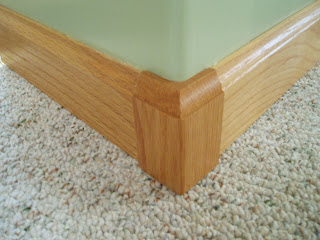
Summary: Wood bullnose corner blocks create an attractive and easy way to trim drywall that has bullnose corners.
Bullnose is a term used in home building construction for both rounded convex (outward) shaped corners and rounded convex (outward) shaped trim pieces, thus the terms bullnose corners and bullnose trim.
Carl,What is your opinion on bullnose corners? What about the baseboards? I've heard some contractors use 90° angle baseboard on bullnosed corners...can that be a problem? Aisha
Hi Aisha, I love bullnose corners.
Yes, 90° (angle) baseboards, besides looking like an amateur trimmed your house, can be a problem when installing tile or hardwood flooring. It’s tough to cut to fit and you end up with a lot space to fill, and there is no satisfactory way to fill this space.
Here’s a simple solution from Distinctive Woodcraft West
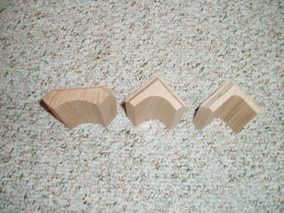
The middle 3/4 " radius is most common and the 3/4" corner bead is commonly sold in home improvement stores and by most drywall contractors.
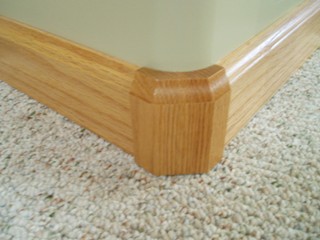
1 1/2 inch radius corner (3 inch diameter circle a little bigger than a tennis ball).
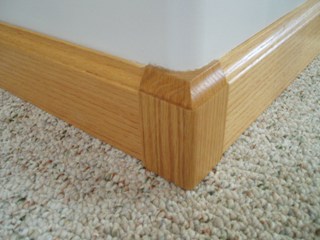
3/4 inch radius corner (1 1/2 inch diameter circle the size of an old silver dollar.
3/8 inch radius corner (3/4 inch diameter circle a little smaller than a nickel).
There are other companies too.
Good job of thinking ahead!
Carl Heldmann
