
- Building Resources
- Construction Loans
- Cost Estimating Explained
- Cost to Build a House
- Cost to Build by State
- Energy Efficient Homes
- Foundation & Basement Information
- Heat Pumps
- Hot Water Recirculation
- House Plans, Reading
- Insulation-Calculator
- Kitchen 1- Design
- Modular vs Stick Built
- Permits, Fees, Surveys
- Radiant Heating
- Remodeling & Additions
- Shell Builders
- Siding-Cement
- Skylights
- Solar Modules
- Stair Building and Design
- Steel Framed Homes
- Subcontractors
- Tankless Water Heaters
- CLICK HERE FOR HUNDREDS OF MORE CATEGORIES
- Build a House
Heat Pumps
Heat Pumps
An air-source heat pump can provide efficient heating and cooling for your home, especially if you live in a warm climate. When properly installed, an air-source heat pump can deliver one-and-a-half to three times more heat energy to a home than the electrical energy it consumes.
This is possible because a heat pump moves heat rather than converting it from a fuel, like in combustion heating systems.
Although air-source heat pumps can be used in nearly all parts of the United States, they do not generally perform well over extended periods of sub-freezing temperatures. In regions with sub-freezing winter temperatures, it may not be cost effective to meet all your heating needs with a standard air-source heat pump.
However, new systems with gas heating as a backup are able to overcome this problem. There is also a "Cold Climate Heat Pump" which shows promise, but is currently facing manufacturing problems. In addition, a version called the "Reverse Cycle Chiller" claims to be able to operate efficiently at below-freezing temperatures.
In cooling mode, an air-source heat pump evaporates a refrigerant in the indoor coil; as the liquid evaporates it pulls heat from the air in the house. After the gas is compressed, it passes into the outdoor coil and condenses, releasing heat to the outside air. The pressure changes caused by the compressor and the expansion valve allow the gas to condense at a high temperature outside and evaporate at a lower temperature indoors.
How They Work
A heat pump's refrigeration system consists of a compressor and two coils made of copper tubing (one indoors and one outside), which are surrounded by aluminum fins to aid heat transfer.
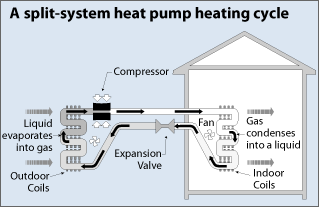
In the heating mode, liquid refrigerant in the outside coils extracts heat from the air and evaporates into a gas. The indoor coils release heat from the refrigerant as it condenses back into a liquid. A reversing valve, near the compressor, can change the direction of the refrigerant flow for cooling as well as for defrosting the outdoor coils in winter.
When outdoor temperatures fall below 40°F, a less-efficient panel of electric resistance coils, similar to those in your toaster, kicks in to provide indoor heating. This is why air-source heat pumps aren't always very efficient for heating in areas with cold winters. Some units now have gas-fired backup furnaces instead of electric resistance coils, allowing them to operate more efficiently.
The efficiency and performance of today's air-source heat pumps is one-and-a-half to two times greater than those available 30 years ago. This improvement in efficiency has resulted from technical advances and options such as these:
In heating mode, an air-source heat pump evaporates a refrigerant in the outdoor coil; as the liquid evaporates it pulls heat from the outside air. After the gas is compressed, it passes into the indoor coil and condenses, releasing heat to the inside of the house. The pressure changes caused by the compressor and the expansion valve allow the gas to evaporate at a low temperature outside and condense at a higher temperature indoors.
• Thermostatic expansion valves for more precise control of the refrigerant flow to the indoor coil
• Variable speed blowers, which are more efficient and can compensate for some of the adverse effects of restricted ducts, dirty filters, and dirty coils
• Improved coil design
• Improved electric motor and two-speed compressor designs
• Copper tubing, grooved inside to increase surface area.
Most central heat pumps are split-systems—that is, they each have one coil indoors and one outdoors. Supply and return ducts connect to a central fan, which is located indoors.
Some heat pumps are packaged systems. These usually have both coils and the fan outdoors. Heated or cooled air is delivered to the interior from ductwork that protrudes through a wall or roof.
Selecting a Heat Pump
Every residential heat pump sold in this country has an EnergyGuide Label, which features the heat pump's heating and cooling efficiency performance rating, comparing it to other available makes and models.
Heating efficiency for air-source electric heat pumps is indicated by the heating season performance factor (HSPF), which is the ratio of the seasonal heating output in Btu divided by the seasonal power consumption in watts.
Cooling efficiency is indicated by the seasonal energy efficiency ratio (SEER), which is the ratio of the seasonal heat removed in Btu per hour to the seasonal power consumption in watts.
The Heating Seasonal Performance Factor (HSPF) rates both the efficiency of the compressor and the electric-resistance elements. The most efficient heat pumps have an HSPF of between 8 and 10.
The Seasonal Energy Efficiency Ratio (SEER) rates a heat pump's cooling efficiency. In general, the higher the SEER, the higher the cost. However, the energy savings can return the higher initial investment several times during the heat pump's life. Replacing a 1970s vintage, central heat pump (SEER = 6) with a new unit (SEER=12) will allow the use of half the energy to provide the same amount of cooling, cutting air-conditioning costs in half. The most efficient heat pumps have SEERs of between 14 and 18.
To choose an air-source electric heat pump, look for the ENERGY STAR® label, which is awarded to those units with SEERs of 12 or greater and HSPFs of 7 or greater. If you are purchasing an electric air-source heat pump and are uncertain whether it meets ENERGY STAR qualifications, look on the bright yellow EnergyGuide label for an efficiency of 12 SEER/7HSPF or greater. For units with comparable HSPF ratings, check their steady-state rating at -8.3 degrees C, the low temperature setting. The unit with the higher rating will be more efficient.
Consider buying a heat pump with an HSPF of at least 7.7. In September 2006, the U.S. Department of Energy will begin enforcing a new standard that will require central heat pumps to have a minimum rating of 7.7 HSPF. In warmer climates, SEER is more important than HSPF; in colder climates, focus on getting the highest HSPF feasible.
These are some other factors to consider when choosing and installing air-source heat pumps:
• Select a heat pump with a demand-defrost control. This will minimize the defrost cycles, thereby reducing supplementary and heat pump energy use.
• If you're adding a heat pump to an electric furnace, the heat pump coil should usually be placed on the cold (upstream) side of the furnace for greatest efficiency.
• Fans and compressors make noise. Locate the outdoor unit away from windows and adjacent buildings, and select a heat pump with an outdoor sound rating of 7.6 bels or lower. You can also reduce this noise by mounting the unit on a noise-absorbing base.
• The location of the outdoor unit may affect its efficiency. Outdoor units should be protected from high winds, which can cause defrosting problems. You can strategically place a bush or a fence upwind of the coils to block the unit from high winds.
Source: EERE (U.S. Department of Energy's Office of Energy Efficiency and Renewable Energy)