
- Ask the Architect-NEW!
- Bathroom – Barrier Free
- Builders Risk Insurance
- Building Material Supplies
- Building a House Step by Step
- Carpentry
- Construction Loans 1
- Cost Estimating Explained
- Cost to Build a House
- Cost to Build by State
- Cracked Flue Liner
- Credit Score Shapeup
- Elevators
- Energy Efficient Homes
- Fire Sprinkler Systems
- Flooring-Concrete Finishes
- Foreclosures
- Foundation & Basement Information
- Gas Fireplaces
- Getting Licensed
- Heat Pumps
- Home Building Budget
- Hot Water Recirculation
- House Plans, Reading
- ICF - Insulated Concrete Forms
- Insulation-Calculator
- Interior Wall Paneling
- Kitchen 1- Design
- Know Your Housing Market
- Landscaping-Xeriscapes
- Log Homes
- Modular vs Stick Built
- Mold Resistant Drywall
- Mortgage Free House
- Octagon Homes
- Paving Mountain Driveways
- Permits, Fees, Surveys
- Plumbing Category Index
- Radiant Heating
- Remodeling & Additions
- Roofing Cost
- Shell Builders
- Siding-Cement
- Skylights-1
- Solar Modules
- Stair Building and Design
- Steel Framed Homes
- Structural Insulated Panels (SIPs) 1
- Stucco
- Subcontractors
- Tankless Water Heaters
- Title Insurance
- Utilities (electric, gas, phone)
- Well & Septic
- Which Window is Best?
- Wind Power
- Yurt Homes
- CLICK HERE FOR HUNDREDS OF MORE CATEGORIES
- Build a House
Geothermal Heat Pumps - Cost - Savings - Rebates - Pond Closed Loops
"Hi Carl, I am building a log home on our property (approximately 3000 sq.ft.)
Mary"
Hi Mary,
As you can see from the NAHB research that went into that article, GEOTHERMAL HEAT PUMPS are very energy efficient, and although their initial cost is 50% to 100% more than an air to air heat pump, they often pay for themselves in 10 years.
Where you are building, and the energy efficiency of your house, will determine how much energy/money you will save; the more frigid the weather, the bigger the savings, the more energy efficient the house, the smaller the savings. Ironic, isn’t it?
By the way, a well built log home is one of the most energy efficient homes you can build!
Keep in mind; we are mainly talking about the “heating phase” of the GEOTHERMAL HEAT PUMP system, as the cooling phase will not provide energy efficiency savings as drastic.
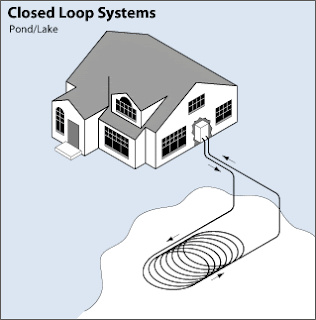
GEOTHERMAL HEAT PUMPS use the relatively constant temperature of the ground or water several feet below the earth's surface as source of heating and cooling. The pipes may be coiled in a slinky shape to fit more of it into a given amount of space. Since it is a closed system, it results in no adverse impacts on the aquatic system.” Here is a link to DSIRE. DSIRE is an excellent comprehensive source of information on state, local, utility, and federal incentives ($) that promote renewable energy and energy efficiency. Thanks for your interest in www.byoh.com.
As for your idea of using your pond for the coils, it would depend on what is allowed by your building inspection department in your locale.
Here is what the California Energy Commission has to say about Pond Closed Loops:
“This type of loop design may be the most economical when a home is near a body of water such as a shallow pond or lake. Fluid circulates underwater through polyethylene piping in a closed system, just as it does through ground loops.
However, this idea, as well as all potential energy savings and technical questions, is something I, as a General Contractor would be expected to research by talking to the experts in the GEOTHERMAL HEAT PUMP industry.
These experts would be (but not limited to) GEOTHERMAL HEAT PUMP manufacturers, dealers recommended by the manufacturer, my building inspection department, & my local electricity supplier (power company) to determine money saved by each system I want to compare. And yes, they (the power company) will, or should, do this for free.
As for rebates, they are out there, but they vary from state to state, and yes, rebates for GEOTHERMAL HEAT PUMPS are available in many states.
I hope I have helped.
Carl