
- Building Resources
- Construction Loans
- Cost Estimating Explained
- Cost to Build a House
- Cost to Build by State
- Energy Efficient Homes
- Foundation & Basement Information
- Heat Pumps
- Hot Water Recirculation
- House Plans, Reading
- Insulation-Calculator
- Kitchen 1- Design
- Modular vs Stick Built
- Permits, Fees, Surveys
- Radiant Heating
- Remodeling & Additions
- Shell Builders
- Siding-Cement
- Skylights
- Solar Modules
- Stair Building and Design
- Steel Framed Homes
- Subcontractors
- Tankless Water Heaters
- CLICK HERE FOR HUNDREDS OF MORE CATEGORIES
- Build a House
House Wrap
House Wrap
One of the many advantages of building your own house today is that they are built better than they were when I started building houses back in the 70’s.
Depending on the size of the house you build and its location, the money saved on energy costs alone can amount to several thousands of dollars per year!
House Wrap is one such energy saver.
This excellent information and the 2 professional videos are from the Michigan bureau of Construction Codes.
Introduction
Housewraps are designed to protect a building from air and moisture penetration. By sealing cracks and gaps in the structure, they keep outside air from penetrating the building envelope, reducing air infiltration and protecting the R-value of the insulation inside the walls. Some housewraps also help protect a building from moisture, reducing mold and mildew and improving the structure's durability.
When properly installed, a housewrap forms a protective layer under a building's siding and over the sheathing. It is literally wrapped around a structure, over the wood or foam sheathing, cut out around windows and doors, and taped at the seams to form a protective barrier.
While perforated housewraps and building felt provide an air barrier only, other wraps, such as spun-bonded wraps, provide a breathable, weather resistant barrier that resists air and moisture infiltration, allows walls to breathe and resists bulk water.
Benefits
When properly installed, weather resistant housewraps provide many benefits:
• Reduce the flow of moisture-laden air into and out of wall cavities, improving air quality
• Reduce air infiltration
• Reduce drafts and improve the thermal performance of exterior walls
• Improve building durability by protecting sheathing and framing from moisture
• Protect wall sheathing when rain and water gets behind siding, brick or stucc
• Improve energy efficiency
• Help prevent mold, mildew and other moisture-related problems
Note:This 1st video is excellent!
It is a scientific overview of air and moisture barriers by building science expert Steve Easley.
Towards the end of the video you will see the difference between breathable wraps and non-breathable wraps.
To view video on MI Bureau of Codes web site Click HERE or on photo.
To view video with Windows Media Player Click HERE
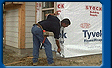
In the next video on installation, Hansen Marketing Tyvek expert, Dean Whitehead, reviews the proper techniques for quality installation of air barriers for building envelopes.
To view video on MI Bureau of Codes web site Click HERE or on photo. To view video with Windows Media Player Click HERE. Hot or cold, Wrap Up!
Carl