

Summary: Land surveys are important. A seller should provide and pay for a land boundary survey. Later on, a foundation survey will show where the house is being built on the land.
A boundary survey measures and locates the property lines. It is based on the legal description of that piece of land. The actual written legal description of the property is called metes and bounds which uses carefully measured distances, angles, and directions.
A foundation survey ensures that minimum property setbacks as required by local zoning and property deed restrictions have not been violated.
Foundation surveys are also called mortgage surveys, or mortgage reports. Your construction loan lender and/or mortgage lender will require such a survey before disbursing any funds (money). You, as the borrower, will be paying for this type of survey.
I have seen foundations that straddled property lines, were built too close to property lines, were in violation of minimum setback requirements, had their well drilled on the neighbor's property, and probably the worst violation of all, had a railroad easement running through the living room.
All these mistakes were made because the home builder started construction before looking at a survey.
All the above problems were eventually resolved, but took a considerable amount of time and money to do so. When setback violations occur, all work stops until the foundation is moved, torn down, partially rebuilt, or a variance issued. In some extreme cases, adjoining property must be purchased.
When drawn out on a piece of paper by a surveyor, a foundation survey looks like this.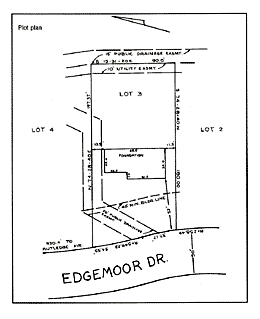
This survey is of lot in a subdivision with the actual foundation drawn in. You can see that this house is a tight fit!
Residential subdivisions have a master survey of all the lots in the subdivision recorded with the local municipality so the actual legal description can be referenced by just a lot number.
If the land you are buying isn't in a subdivision, the legal description of the piece of land you are buying will be written out.
Here is an example of a legal description in metes and bounds:
SE1/4 of NW1/4 of Section 3, T3N, R1E, 3rd PM would be the southeast quarter of the northwest quarter of section 3 in township 3 north, range 2 east of the 3rd Principle Meridian. Whew! Good thing land surveyors can draw these out isn't it?
The legal description on your survey should match the legal description on your “deed” and the legal description on your “title insurance policy”.
Note: Always get Title Insurance for the land purchase. Seller should pay for this.
Be sure to read my Building a House Step by Step.
Carl Heldmann
