

Sewer Line Installation. Sewer lines should be below the house footings and the frost line.
Hi Carl,
Thanks for the great website and book!
One thing that I have a question on and I haven’t seen covered is about the sewer line leaving the basement.
If you have gravity draining basement bathroom does that mean that the sewer line is run below the footing or possibly right above it?
If it is below when does that get put in?
Thanks, Richard
Hi Richard,
This is mentioned in Chapter 8 of my book, Step # 6.
But here is an excellent schematic, courtesy of, the Village of South Holland, IL. that pictorially tells the story of how sewer lines and other drain lines should be run.
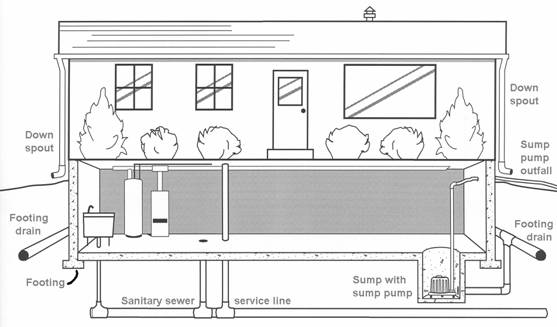
At any rate, sewer lines should be below the footings. Having the sewer line above the footing could lead to hydrostatic pressure causing ground water leaks in the future. Have your plumber coordinate the location of the sewer line trench with your footing/foundation subcontractor.
Exterior footing drains, installed correctly, as well as a sump pump in the basement (with a battery backup) need to be installed to prevent possible hydrostatic pressure causing ground water leaks in the future.
If the exterior footing drain clogs hydrostatic pressure could build up against your basement wall. That water will force its way through to your home taking the path of least resistance. That path could be between the foundation wall and the foundation footing or between the foundation wall and the basement floor.
Even if you were not going to have plumbing in the basement, the sewer line needs to be run under the footing, as this not only helps prevent leaks but assures that the sewer line is below the frost line”.
It needs to be below the frost line so that the ground won’t freeze and heave and break the line or freeze the effluent.
In the event you (or anyone else) don’t have enough “fall” to the main sewer line, you could use a “lift station”. A lift station does just what the name suggests. I t pumps sewage up to the main sewer line or sewer lateral.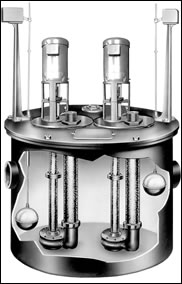
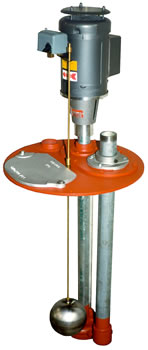
Courtesy of Tramco Pump Co
Even with a lift station, the sewer line needs to go under the footing.
In warmer climates where the frost line is near grade level, and if the house is built on a crawl space or there is no plumbing in the basement, the sewer line could go through the wall above the footing as long as it stays below the frost line.
Richard, I hope I have answered your question.
Thanks for your interest in www.byoh.com, Carl Heldmann.
