

Summary: Crawl Space Moisture Control is critical because crawl space moisture causes serious structural and health problems. A dry crawl space is essential for an energy efficient and healthy home.
Due to exposed damp earth and moisture in the air due to high humidity in certain geographic areas, a crawl space can become as damp as a steam bath.
When this happens, condensation can occur on the foundation walls, the floor joists above the crawl space and on the insulation that is between those floor joists.
This not only lowers the effectiveness of the floor insulation but also promotes mold, mildew, insects, and eventually wood rot. It can even cause wood floors in the living area above to buckle or cup.
Crawl space moisture can be controlled two ways; by venting the crawl space or sealing the crawl space.
Vented Crawl Space
In my opinion, based on my home building experience, venting a crawl space and providing an effective ground seal or crawl space vapor barrier is the best way to establish crawl space moisture control. The vapor barrier should be of a greater thickness than 6 millimeters, and should be overlapped at the seams and run up and secured at the foundation walls. Vapor barrier installation is not an easy job.
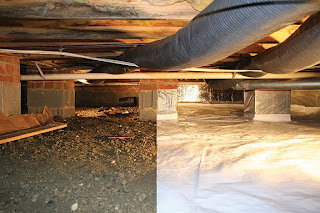
Courtesy of crawlspacesystems.net
Once the moisture barrier is applied, one must be careful not to cause rips or tears in it.
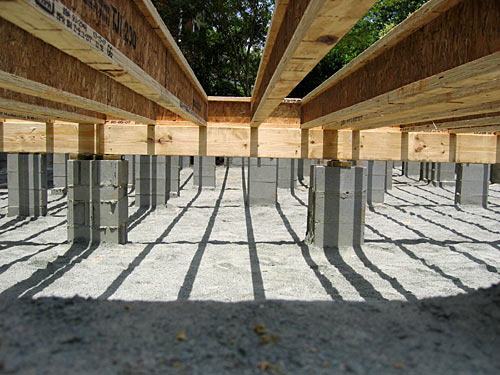
The ground on the crawl space floor should be smooth with a slight grade to a low grade point if possible.
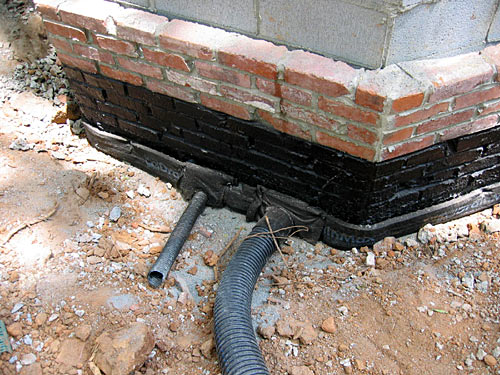
Crawl space drainage should be provided in case of an infiltration of water. This can be done by connecting a drainage pipe to the footing drain.
An adequate number of foundation vents with cross ventilation is absolutely necessary and a power ventilator may be required if there is not sufficient cross ventilation.
Air circulation in the crawl space will keep humid air from condensing, just like the wind keeps dew from forming on the grass outside on a summer’s morning.
In the winter, you can close the foundation vents as both the relative humidity and dew point (the point at which moisture condenses) drop with the outside air temperature.
Sealing a Crawl Space or Closed Crawl Space
A sealed crawl space is like a mini basement with a dirt floor and no head (or shoulder) room without the benefits of a basement.
Sealing the crawl space involves sealing or eliminating the foundation vents, a vapor barrier as in the vented method, and rigid insulation or a vapor barrier applied to the inside of the crawl space walls.
Running a dehumidifier is required and a sump pump is recommended.
“An important part of a sealed crawl space is a reliable sump pump system. Without one, your crawl space will still be vulnerable to groundwater, as well as unnoticed plumbing leaks.”
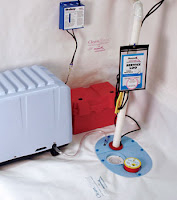
Sump pump and dehumidifier
Courtesy of Crawl Space Solutions of Arkansas
Sealing a crawl space should be done by a professional who not only is licensed and has good references, but who unconditionally guarantees the work. It is a hard job.
Advanced Energy has some excellent information and videos on sealing a crawl space or as they call it, closed crawl spaces.
Both Crawl Space Moisture Control methods assume that the exterior walls of the crawl space foundation have been properly waterproofed with footing drains installed properly, and proper grading and drainage have been accomplished.NOTE: Waterproofing a crawl space must be done before you can even think of controlling moisture.
Carl Heldmann
