- Ask the Architect-NEW!
- Bathroom – Barrier Free
- Builders Risk Insurance
- Building Material Supplies
- Building a House Step by Step
- Carpentry
- Construction Loans 1
- Cost Estimating Explained
- Cost to Build a House
- Cost to Build by State
- Cracked Flue Liner
- Credit Score Shapeup
- Elevators
- Energy Efficient Homes
- Fire Sprinkler Systems
- Flooring-Concrete Finishes
- Foreclosures
- Foundation & Basement Information
- Gas Fireplaces
- Getting Licensed
- Heat Pumps
- Home Building Budget
- Hot Water Recirculation
- House Plans, Reading
- ICF - Insulated Concrete Forms
- Insulation-Calculator
- Interior Wall Paneling
- Kitchen 1- Design
- Know Your Housing Market
- Landscaping-Xeriscapes
- Log Homes
- Modular vs Stick Built
- Mold Resistant Drywall
- Mortgage Free House
- Octagon Homes
- Paving Mountain Driveways
- Permits, Fees, Surveys
- Plumbing Category Index
- Radiant Heating
- Remodeling & Additions
- Roofing Cost
- Shell Builders
- Siding-Cement
- Skylights-1
- Solar Modules
- Stair Building and Design
- Steel Framed Homes
- Structural Insulated Panels (SIPs) 1
- Stucco
- Subcontractors
- Tankless Water Heaters
- Title Insurance
- Utilities (electric, gas, phone)
- Well & Septic
- Which Window is Best?
- Wind Power
- Yurt Homes
- CLICK HERE FOR HUNDREDS OF MORE CATEGORIES
- Build a House
Creating an Arched Door or Entry - The Easy Way
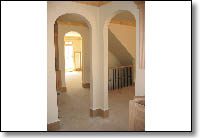
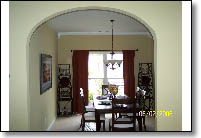
Creating Arched Openings -The Easy Way
How do you get the beauty of curved arches & walls without having to find the skilled craftsman who knows how to do them, or paying more for labor intensiveness?

I used to drive my carpenters nuts with curved arches (I love them), but not now.
Here's the answer.
From: the NAHB Research Center:
Flexible Framing:
Effortless framing of curved planes - from walls to soffits to door and window arches.
Summary:
Curved walls, arched doorways, arched entries, and arched openings can add dramatic visual impact to interiors, but they required a high degree of craftsmanship to execute. Now, they don’t have to be time consuming and difficult to install. The old framing method of laying out plywood templates and cutting tedious patterns can be replaced with new systems that aid framers in creating a variety of undulating patterns in virtually any configuration or application. Framers can utilize many of the same framing materials that are already on site to complete any number of architectural assemblies with these steel tracks and pre-formed arches.
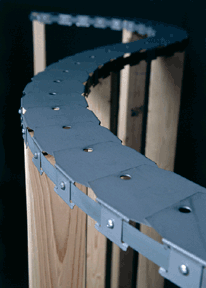
One product, Flex-C Trac, is a flexible track that forms the top and bottom “plates” of either a wood or cold-formed steel studded wall and is easily adjustable to form precise curves of any radius. The web of the track consists of a series of 20-guage overlapping plates, linked to form flexible vertebrae, allowing the track to flex to any arc. Tabs on each plate hold metal straps that form flanges on both sides of the channel. Screws are fastened through the guide-holes on each tab once the screws pierce the flange straps and the track is locked into the shape that was made with the track. After the tracks are secured, steel or wood studs are positioned within the track and screwed into place.
Here is a video from Flex-C:
The track comes in 3½-inch and 5½-widths that are limited in use only by one’s imagination, as the manufacturer shows the material used to frame curved lighting soffits, window awning frames, barrel vault ceilings and columns. Other similarly innovative products are also offered by Flex-C Trac’s manufacturer.
Another product, Easy-Arch™, is a simple curved piece of sheet steel that can be fastened within a rectangular opening to create an arch. The track’s web and flanges form the nail base to support the gypsum board wall finish. Easy-Arch™ comes in sizes that accommodate 2x4 and 2x6 framing and can be used in tandem with cold-formed steel or wood framing.
PATH Attributes
Flexible framing reduces the labor cost for creating curved walls and ceilings.
The flexible channel simplifies the process of creating precise, curved ceilings and walls.
______________________________________
Ease of Implementation
Installation involves conventional tools and carpentry techniques. Bear in mind, however, that trades following the framing carpenter, such as the gypsum board installers and trim carpenters, will also require specialty skills or products or both to finish these specialty trades. For example, gypsum board that covers radius curves requires wetting and scoring to follow the frame shape and trim material will require similar flexibility. Be prepared to follow these new framing products with other new products that are on the market like ¼” high flex gypsum board and flexible plastic trim.
_____________________________________
Initial Cost
Specialty framing products cover a broad range of prices. Expect to pay anywhere from $3-$10 per foot, subject to minimum order sizes.
________________________________________
U.S.Code Acceptance
Building codes do not include prescriptive methods for these products used in structural applications, like plates for bearing walls. Products should be used in non-structural applications where the track or feature is merely a gypsum board or similar finished nailing surface or under the guidance of a professional engineer’s review and approval.
________________________________________
Installation
Flexible track sections come in 10 foot lengths that can be cut to exact size. Masking tape placed along the flange edge of the Flex-C track holds the shape temporarily until the screws are set. Once the base track has been locked into position, it can be used as a template for the top track as required. Installation would take place at the same time other walls are being laid out and installed.
The track works well for remodeling jobs and basement or tenant build-outs, as well.
Preformed arches are also installed at the rough frame stage. For installation in bearing walls, headers are merely installed at the plate-line (higher than the standard opening height limit) and the arch is inserted lower in the opening to serve as a gypsum board nailing surface.
________________________________________
Benefits/Costs
The advantages of flexible framing products is the ease with which curved walls, arched ceilings, soffits, and other features can be created. The products make it simpler to form architectural features common to highly-crafted custom homes while eliminating the labor intensiveness of these designs.
Products are generally for non-load bearing applications.
Disclaimer: The information on the system, product or material presented herein is provided for informational purposes only. The technical descriptions, details, requirements, and limitations expressed do not constitute an endorsement, approval, or acceptance of the subject matter by the U.S. Department of Housing and Urban Development (HUD/FHA), The Partnership for Advancing Technology in Housing (PATH), or any PATH-affiliated Federal agency or private company. There are no warranties, either expressed or implied, regarding the accuracy or completeness of this information. Full reproduction, without modification, is permissible.