

- Building Resources
- Construction Loans
- Cost Estimating Explained
- Cost to Build a House
- Cost to Build by State
- Energy Efficient Homes
- Foundation & Basement Information
- Heat Pumps
- Hot Water Recirculation
- House Plans, Reading
- Insulation-Calculator
- Kitchen 1- Design
- Modular vs Stick Built
- Permits, Fees, Surveys
- Radiant Heating
- Remodeling & Additions
- Shell Builders
- Siding-Cement
- Skylights
- Solar Modules
- Stair Building and Design
- Steel Framed Homes
- Subcontractors
- Tankless Water Heaters
- CLICK HERE FOR HUNDREDS OF MORE CATEGORIES
- Build a House
Wood Interior Wall Paneling System-Wainscoting
Wood Interior Wall Paneling System
I have always thought that wainscot paneling adds an elegance and distinction to the interior of finer living spaces.
But they are somewhat expensive, or at least they used to be.
Now, you too can experience the timeless look and ambience of a traditional living space with wainscot interior wall paneling from WainscoatingAmerica.com.jpg)
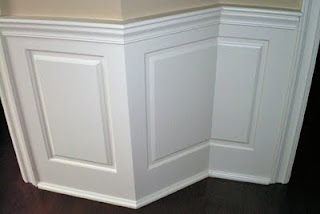
Read how Wood Interior Wall Paneling Systems are an affordable alternative to custom millwork from NAHB Research Center:
Summary from NAHB Research Center:
The wood paneling system is designed for interior finishes such as wainscots and wall paneling. Each panel has a hardwood veneer bonded to an engineered wood substrate such as medium density fiberboard (MDF) or wheatstraw board. This can reduce the cost when compared to custom millwork by as much as two-thirds. Additionally, this system helps extend scarce hardwood resources and uses recycled materials.
Photo: NAHB Research Center
The wood paneling system is designed for interior finishes such as wainscots and wall paneling. Each panel has a hardwood veneer bonded to an engineered wood substrate such as medium density fiberboard (MDF) or wheatstraw board. This can reduce the cost when compared to custom millwork by as much as two-thirds. Additionally, this system helps extend scarce hardwood resources and uses recycled materials.
The interior wall paneling system is used exactly like any hardwood paneling in interior finish applications. It is a pre-cut system where pre-machined stiles, rails, and panel pieces are assembled and installed with minimal cutting and sanding. This allows the appearance of custom built paneling at significantly less cost of materials and labor.
Panels and rails can be stacked to create full wall paneling options. MDF is made from highly refined wood fibers combined with a binding agent and pressed into a composite wood product that is uniform and dimensionally stable. Wheatboard is made with discarded wheat straw from farming operations. The straw material is processed into substrate panels that have excellent stability and strength.
PATH Attributes:
. The fact that these products use less wood and actually recycle material, they cost much less than a similar product using actual wood.
. Wood is a declining resource. Because these products are made of compressed straw and recycled manufactured wood products, they use significantly less wood than authentic wood wall décor.
. These products hold up as long or longer than other actual wood decor due to their treatment and manufacture. They can usually be cleaned with conventional cleaning agents and are rather strong for their cost as well.
Ease of Implementation:
As with most wood products, there are limitations as to the exposure to water and extreme temperatures. Extremely humid areas inside the house should be avoided, or humid air must be removed or controlled. Exposure to temperatures over 120 degrees Fahrenheit should be avoided. Exterior applications are not recommended.
Initial Cost:
Prices will vary according to material and finish, height desired and whether the paneling will be used in a staircase or not. For a roughly 3 foot tall application, $10 to $35 per square foot is typical.
U.S. Code Acceptance:
Substrate material shall be industrial grade or moisture resistant MDF (product class MD) or EFB wheatboard (Industrial Grade particleboard, class M3), complying with the latest edition of ANSI standard A208.2 - 1994, "Medium Density Fiberboard for Interior Use". Adhesive for bonding veneers to substrate shall be PVA, EVA, or PUR type adhesive. Real wood veneer shall be grade A, sanded to 180 grit. Paint able veneer shall be recoatable paper, 80-gm. weight. Primer shall be flat (<10) white, 34% solids content, 1.0 - 1.5 mils thick.
Installation:
Pre-cut kit installation starts with the placement of the bottom rail. The tongue and groove stiles and panels are snapped in and glued to hold them in place. Then the components are nailed (8d-finish) or screwed (#7 x2-1/4 - trim head). The installation can be performed with ease by a homeowner with moderate skills and basic hand tools such as a hammer, drill, caulk gun and adhesive, measuring device, and saw.
Warranty:
Typically 1 year from the date of purchase with proper installation and upkeep.
Benefits/Costs:
Material cost saving, when compared to traditional wood panels, can be significant. Labor cost saving with the kit system is also significant when compared to cutting and fitting hardwood stock. Since the substrate is composed of MDF or wheatboard, valuable resources are preserved and recycled materials are used in a beneficial manner.
Since these substrate materials are dimensionally stable, warping and cracking, and other cosmetic problems experienced with hardwood stock are eliminated.
Disclaimer: The information on the interior wall paneling system, product or material presented herein is provided for informational purposes only. The technical descriptions, details, requirements, and limitations expressed do not constitute an endorsement, approval, or acceptance of the subject matter by the U.S. Department of Housing and Urban Development (HUD/FHA), The Partnership for Advancing Technology in Housing (PATH), or any PATH-affiliated Federal agency or private company. There are no warranties, either expressed or implied, regarding the accuracy or completeness of this information. Full reproduction, without modification, is permissible.
