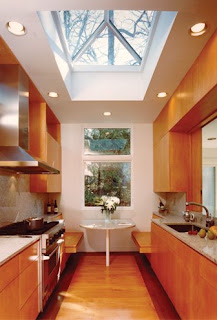

Skylights

Skylights


Years ago, we (my fellow home builders and I) used to call skylights "skyleaks". If you had a skylight it leaked, both water and energy.

Well, design and knowledge on "proper" installation by a "professional" installer have made skylights more water tight and more energy effiicient.

Skylights and Roof Windows are great for adding "Wow" to any room.

Here's some info from the U.S. Department of Energy.

Skylight Design Considerations
Before selecting a skylight for your home, you need to determine what type of skylight will work best and where to improve your home's energy efficiency.

Energy Performance
First, it's a good idea to understand the energy performance ratings of skylights if you don't already. You can then determine what energy performance ratings you need for your skylight based on your climate and home's design.

For labeling energy-efficient skylights, ENERGY STAR® has established minimum energy performance rating criteria by climate. However, this criteria doesn't account for a home's design.

Therefore, if you're constructing a new home or doing some major remodeling, you should also take advantage of the opportunity to incorporate your skylight design and selection as an integral part of your whole-house design—an approach for building an energy-efficient home.

Photos courtesy of Wasco
 

Size and Position

The physical size of the skylight greatly affects the illumination level and temperature of the space below.

As a rule of thumb, the skylight size should never be more than 5% of the floor area in rooms with many windows and no more than 15% of the room's total floor area for spaces with few windows.

You should also consider a skylight's position if you want to maximize daylighting and/or passive solar heating potential.

Skylights on roofs that face north provide fairly constant but cool illumination. Those on east-facing roofs provide maximum light and solar heat gain in the morning.

West-facing skylights provide afternoon sunlight and heat gain. South-facing skylights provide the greatest potential for desirable winter passive solar heat gain than any other location, but often allow unwanted heat gain in the summer.

You can prevent unwanted solar heat gain by installing the skylight in the shade of deciduous (leaf-shedding) trees or adding a movable window covering on the inside or outside of the skylight. Some units have special glazing that can help control solar heat gain.