
- Ask the Architect-NEW!
- Bathroom – Barrier Free
- Builders Risk Insurance
- Building Material Supplies
- Building a House Step by Step
- Carpentry
- Construction Loans 1
- Cost Estimating Explained
- Cost to Build a House
- Cost to Build by State
- Cracked Flue Liner
- Credit Score Shapeup
- Elevators
- Energy Efficient Homes
- Fire Sprinkler Systems
- Flooring-Concrete Finishes
- Foreclosures
- Foundation & Basement Information
- Gas Fireplaces
- Getting Licensed
- Heat Pumps
- Home Building Budget
- Hot Water Recirculation
- House Plans, Reading
- ICF - Insulated Concrete Forms
- Insulation-Calculator
- Interior Wall Paneling
- Kitchen 1- Design
- Know Your Housing Market
- Landscaping-Xeriscapes
- Log Homes
- Modular vs Stick Built
- Mold Resistant Drywall
- Mortgage Free House
- Octagon Homes
- Paving Mountain Driveways
- Permits, Fees, Surveys
- Plumbing Category Index
- Radiant Heating
- Remodeling & Additions
- Roofing Cost
- Shell Builders
- Siding-Cement
- Skylights-1
- Solar Modules
- Stair Building and Design
- Steel Framed Homes
- Structural Insulated Panels (SIPs) 1
- Stucco
- Subcontractors
- Tankless Water Heaters
- Title Insurance
- Utilities (electric, gas, phone)
- Well & Septic
- Which Window is Best?
- Wind Power
- Yurt Homes
- CLICK HERE FOR HUNDREDS OF MORE CATEGORIES
- Build a House
Building the House Step by Step
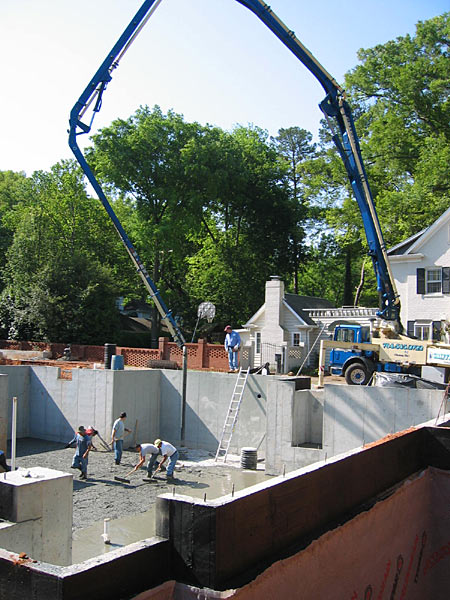
STEP 7: Concrete Slabs - for Heated Areas (1-2 days)
Many locales require slab perimeter insulation. The most common perimeter insulation is extruded polystyrene foam board (poly), which is available in various thicknesses. The board extends from the top of the foundation to at least 12 inches below finished grade. I recommend a 1-inch or thicker board, even if it is not required by codes. I also recommend using a plastic barrier of 4 to 6 mil thickness under the concrete to prevent moisture from working up into the concrete. A 6-by-6-inch #10 wire mesh should be placed in the concrete to reinforce it.
The top of the slab should be at least 8 inches above the finish grade. Your sub should put down a base for the slab, tamping down gravel or crushed stone to form a layer 4 to 6 inches in depth. The poly goes down on this just prior to pouring the concrete. If you cannot cover the entire area with one sheet of poly, any joints of the poly should overlap by 4 inches and be sealed with silicone caulk. The wire mesh is laid on top of the poly. Call for an inspection before pouring concrete if your code requires it.
A good concrete sub will do all of this. I stopped checking my slab pourings when I found a terrific concrete subcontractor.
For garage slabs, with proper backfilling and tamping, you don't need the wire mesh, but if you believe the added strength is required, use it. I recommend an expansion joint of fiberboard around the perimeter. Garages are subject to extreme temperature changes, and concrete expands and contracts with those changes. The expansion joint permits this expansion without cracking the concrete. Both this slab and the house slab should be at least 4 inches thick. Be sure your sub thickens all slabs wherever they will be carrying load-bearing posts or walls. Codes differ on the additional thickness required, but it is often the thickness of the footings.
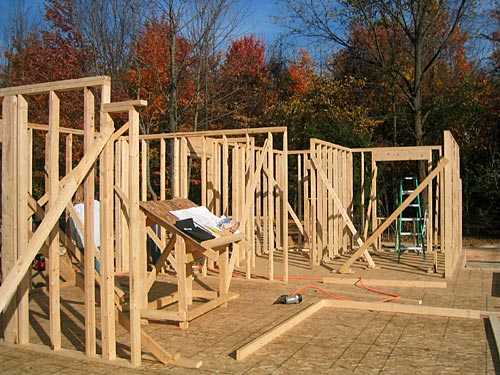
STEP 8: House Framing (1-3 weeks)
If you have a good carpenter, this is the end of this section of framing. And if that sounds too simple, wait and see. You need only order the lumber, the windows, and the exterior doors, and in two or three weeks you'll have a house (or at least something that looks like a house). I have included here a typical order list for framing and drying-in, which means making the house secure from rain. Rain or snow during framing is not desirable, but it seldom does much damage beyond an occasional warped piece of lumber. But once the house is dried-in, the work inside can progress regardless of the weather if windows and doors are in place.
You will want to check with your carpenter about any problems with materials. Because it is impossible to estimate exact needs in materials, some ordering will have to be done during the course of construction.
You could give your carpenter permission to order what he needs and then tell the supply house what you have done. The decision is up to you. I do it.
When the framing is completed, order cabinets, bookcases, and vanity cabinets, if there are any. Space for them can now be measured on the job by the salesman.