

- Average Cost to Build a House
- Cheap Windows
- How to Find Contractors
- Metal Roofing Cost
- How to be a General Contractor
- Cost Per Square Foot to Build
- Cost to Build by State
- Cost of Home Additions
- Roofing Cost
- How to Control Construction Cost
- List of Contractors You Will Need
- Cost to Build a House
- Buying Land to Build On
- Low Down Payment Mortgage
- Basement Construction Cost
- Basement Costs per Square Foot
- Cost to Build a Kit Home
- New Home for Under 70,000
- Cost to Build House vs. Appraised Value
- How to Get a Construction Loan
- Modular vs Stick Built
- Remodeling & Additions
- FREE Credit Score Calculator
- Construction Bids
- Solar Roof Shingles
- Cost To Build in California
- New Home Plans
- Ask the Architect
- Construction Loans
- Cost Estimating Explained
- Foundation & Basement Information
- Insulation-Calculator
- Attic Insulation
- Bad Credit Home Loans
- Building Resources
- CLICK HERE FOR HUNDREDS OF MORE CATEGORIES
- Home Building
Insulated Vinyl Siding with Installation Videos
Summary: Insulated vinyl siding has foam insulation laminated to the back of regular vinyl siding that makes the siding more energy efficient, more durable, more sound proof, easier to install, and impact resistant.
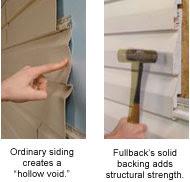
Regular vinyl siding is subject to damage from impact, wind, and weather.
There is also a hollow space between the siding and the exterior wall that traps moisture and limits energy efficiency.
Insulated vinyl siding improves the appearance of your home, as the waviness associated with vinyl siding is reduced.
According to the National Association of Home Builders Research Center, the cost of insulated vinyl siding is about the same as the cost of non-insulated vinyl siding over ¾ inch foam sheathing.
Installation is easier as insulated vinyl siding is more rigid and won’t bow and sag as easily as vinyl siding, making it easier to measure, cut, and nail.
Here are three excellent videos, including an insulated vinyl siding installation video, and more information on insulated vinyl siding from the Michigan Bureau of Construction Codes.

Carl Heldmann


